

Cost-Effective Eco-Solvent Ink Solutions for 2026
Table of Contents
- What Is Eco-Solvent Ink and Why It Matters for Your Print Shop
- Eco-Solvent Ink vs Solvent Ink Comparison: Key Differences
- Bulk Eco-Solvent Ink for Wide Format Printers: Sizing Your Supply
- Cost-Effective Eco-Solvent Ink Solutions by Printer Model
- Best Practices for Eco-Solvent Ink Maintenance and Printhead Health
- Total Cost of Ownership: Calculating Real Savings
- Troubleshooting Common Eco-Solvent Ink Print Quality Issues
- VOC Compliance and Environmental Standards for Eco-Solvent Inks
Last Updated: August 30, 2026
What Is Eco-Solvent Ink and Why It Matters for Your Print Shop
Eco-solvent inks balance quality demands and operational costs by using milder solvents that reduce environmental impact while maintaining durability and color vibrancy on outdoor substrates. Unlike traditional solvent-based inks that emit high levels of volatile organic compounds (VOCs), eco-solvent formulations cure through evaporation or mild heat, enabling lower maintenance costs, fewer printhead clogs, and easier compliance with environmental standards.
Eco-solvent's cost-effectiveness comes from the refillable cartridge model. Rather than replacing entire cartridges at OEM prices, shops purchase bulk eco-solvent ink in 500ml or 1000ml bottles and refill compatible cartridges multiple times, working best on wide format printers designed for high-volume production.
Eco-Solvent Ink vs Solvent Ink Comparison: Key Differences
Traditional solvent-based inks use aggressive petroleum solvents (like toluene and xylene) that dissolve ink pigments and enable adhesion to non-porous substrates. Eco-solvent inks achieve similar results using milder solvents with lower volatility, producing less VOC emissions and easier regulatory compliance.
Both deliver vibrant color, excellent outdoor durability, and UV resistance on vinyl, mesh, and banner materials. Eco-solvent inks dry slightly slower (30-60 seconds versus 15-30 seconds), which is negligible for most shops. The real advantage is printhead longevity: milder solvent chemistry reduces nozzle clogging and printhead degradation, meaning fewer maintenance cycles and less downtime. Cost-effectiveness favors eco-solvent decisively when factoring in total operating expenses and the refillable cartridge model.
| Attribute | Traditional Solvent | Eco-Solvent |
|---|---|---|
| Solvent Type | Petroleum-based (toluene, xylene) | Biodegradable or water-based |
| VOC Emissions | High (requires ventilation) | Low (minimal ventilation needed) |
| Drying Time | 15-30 seconds | 30-60 seconds |
| Printhead Clogging | More frequent | Less frequent |
| Outdoor Durability | Excellent | Excellent |
| UV Resistance | High | High |
| Refillable Cartridge Option | Limited | Widely available |
| Cost Per Milliliter | Higher | Lower (with bulk refills) |
| Regulatory Compliance | Stricter oversight | Simpler compliance |
Bulk Eco-Solvent Ink for Wide Format Printers: Sizing Your Supply
Wide format printers used for production printing consume 50-200ml of ink per day depending on coverage and resolution. A print shop running one wide format printer 8 hours daily typically uses 400-800ml weekly, making a 1000ml bulk bottle a sensible monthly supply.
Small bottles (140ml, 240ml) suit occasional users or shops testing a new system. High-volume shops benefit from 1000ml bottles, which reduce per-milliliter cost and minimize reordering frequency, though they require cool, dark storage with a 12-18 month shelf life.
For Epson EcoTank Pro models like the ET-16600 and ET-16650, a four-bottle 1000ml set costs $174.95 and typically supplies 4-6 weeks of moderate production. For the Epson SureColor T-series (T3000, T5000, T7000, T3270, T5270, T7270), which accommodate five colors including matte black, a five-bottle 1000ml set runs $219.95.
A common approach is to order enough bulk ink to cover 6-8 weeks of production, balancing cost savings against freshness.
Cost-Effective Eco-Solvent Ink Solutions by Printer Model
Epson EcoTank Pro ET-16600 and ET-16650 Ink Options
The Epson EcoTank Pro series uses integrated ink tank systems rather than traditional cartridges, holding significantly more ink in built-in reservoirs. These printers accept four-color eco-solvent ink systems (black, cyan, magenta, yellow) and are compatible with refillable bulk bottles.
Printer Ink Pro offers a 1000ml four-bottle set at $174.95, providing the best cost per milliliter for steady production. A single set supplies approximately 4-6 weeks of moderate use, translating to roughly $30 per week in ink costs. Smaller trial sizes (240ml at $49.95 or 140ml at $29.95) suit shops evaluating performance before committing to bulk purchasing.

The EcoTank Pro's integrated reservoir design minimizes waste and reduces printhead maintenance compared to traditional cartridge systems.
Epson SureColor T-Series (T3000, T5000, T7000, T3270, T5270, T7270) Solutions
The SureColor T-series supports five-color systems (photo black, cyan, magenta, yellow, and matte black), enabling richer tonal range and more versatile substrate compatibility.
Printer Ink Pro offers 1000ml five-bottle sets for $219.95, providing comprehensive color coverage for sustained production. Smaller trial sizes (240ml at $62.95) allow evaluation without large upfront investment.
The five-color system's advantage is tonal depth. Photo black handles fine art and photographic output, while matte black is optimized for sticker and decal production. A 1000ml five-bottle set at $219.95 breaks down to $43.99 per color. For a shop printing 50-100 wide format pieces weekly, a single five-bottle set supplies 6-8 weeks of production.
Best Practices for Eco-Solvent Ink Maintenance and Printhead Health
Printhead longevity determines whether eco-solvent inks deliver true cost savings. Eco-solvent inks clog less frequently than traditional solvents because of their milder chemistry, but neglecting maintenance still causes problems.
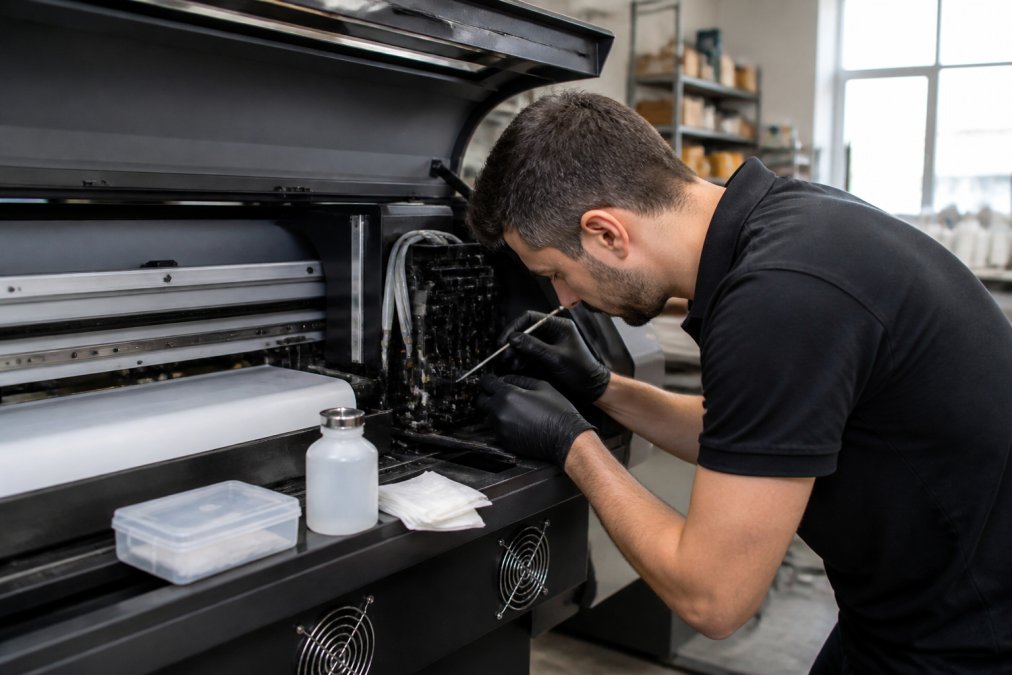
Run a light cleaning cycle every 2-3 days if the printer sits idle, and a full cleaning cycle weekly if production is consistent. Avoid running full cleaning cycles too frequently, as this wastes ink without additional benefit.
Ink viscosity determines clogging risk. Eco-solvent inks have specific viscosity ranges (typically 8-12 centipoise) that optimize flow through nozzles. Temperature affects viscosity: cold inks thicken and flow poorly, while warm inks thin and may cause banding. Store bulk eco-solvent ink bottles at 65-75°F. If your print shop is cold, allow ink bottles to sit at room temperature for 2-3 hours before refilling reservoirs.
Eco-solvent inks are formulated for non-porous materials: vinyl, polyester, synthetic fabrics, and coated banners. Printing on porous substrates (uncoated paper, raw canvas) can cause ink to absorb unevenly, leaving pigment deposits in nozzles that harden and clog.
For shops closing for a week or longer, run a full cleaning cycle before shutting down and again when restarting.
Total Cost of Ownership: Calculating Real Savings
Cost-effectiveness requires accounting for ink, cartridge or refill system costs, maintenance supplies, labor time, and downtime from equipment failures.

A shop running one Epson SureColor T5000 with moderate production (40 wide format prints weekly, average 50% ink coverage) consumes roughly 200ml of ink per week. Using OEM cartridges, this shop would replace one five-color cartridge set every 3-4 weeks at approximately $600-750 per set. Annual OEM ink cost: $7,800-9,750.
Switching to bulk eco-solvent ink: a 1000ml five-bottle set at $219.95 supplies 5 weeks of production. Annual bulk ink cost: $2,287.40. That's a direct savings of $5,500-7,500 annually on ink alone.

Eco-solvent inks reduce printhead maintenance frequency and downtime. A shop using OEM cartridges typically experiences one 4-hour printhead cleaning session per month due to cartridge-related clogs, losing 48 hours annually. At $200-400 per hour in lost revenue, that's $9,600-19,200 in lost opportunity. Eco-solvent inks, with proper maintenance, can reduce unplanned downtime.
| Cost Category | OEM Cartridges | Eco-Solvent Bulk |
|---|---|---|
| Ink (annual) | $8,500 | $2,300 |
| Maintenance labor | $200 | $75 |
| Cleaning solutions | $100 | $50 |
| Downtime (lost revenue) | $12,000 | $3,000 |
| Total Annual Cost | $20,800 | $5,425 |
| Savings | $15,375 |
Initial investment is a single bulk set ($174.95-$219.95) and a basic refilling kit. Total setup cost: under $250. Payback occurs within the first month of production.
Troubleshooting Common Eco-Solvent Ink Print Quality Issues
Banding (horizontal lines across the print) occurs when nozzles are partially clogged or when ink viscosity is inconsistent. Run a light cleaning cycle and reprint. If the problem persists, check ink storage temperature. Warm the bulk bottle to room temperature (65-75°F) and refill the reservoir. If banding continues, run a full cleaning cycle.
Color shifts happen when one color's nozzles are clogged while others function normally. Run a cleaning cycle, then print a test pattern to identify which color is affected. If the problem persists after two cleaning cycles, the issue is likely ink viscosity or a deeper printhead problem requiring professional service.
Ink adhesion failures occur when eco-solvent ink doesn't bond properly to the substrate. This happens when using incompatible media. Eco-solvent inks are formulated for non-porous substrates: vinyl, synthetic fabrics, coated banners. If the substrate is correct and adhesion still fails, the issue is usually curing temperature.
Printhead strikes occur when the printhead physically contacts the substrate. Check that your substrate thickness matches the printer's specifications (typically 0.5-1.5mm for wide format printers). If the substrate is within spec and strikes continue, inspect the media path for debris or misalignment.
VOC Compliance and Environmental Standards for Eco-Solvent Inks
Eco-solvent inks exist because regulations around volatile organic compounds have become stricter. In the United States, VOC emissions from printing operations are regulated by the Environmental Protection Agency (EPA) under the Clean Air Act. The EPA's National Emissions Standards for Hazardous Air Pollutants (NESHAP) establish limits on VOC emissions from printing facilities. Non-compliance results in fines up to $37,500 per day per violation.
Eco-solvent inks contain significantly lower VOC concentrations than traditional solvents. Most eco-solvent formulations contain less than 50% VOC by volume, compared to 80-95% for traditional solvents. This lower VOC content means smaller or less expensive ventilation systems are required, fewer regulatory monitoring obligations, and reduced personal protective equipment requirements for staff.
The Occupational Safety and Health Administration (OSHA) regulates workplace exposure to solvent vapors. Eco-solvent inks, with their milder chemistry, fall below these thresholds in most applications, reducing worker health risks.
Some states have additional VOC restrictions. California enforces stricter VOC limits than federal EPA standards. The South Coast Air Quality Management District (SCAQMD) in Southern California requires printing facilities to use low-VOC inks or implement expensive emission control equipment. Shops in California using eco-solvent inks avoid these additional compliance costs entirely.
For new shops, choosing eco-solvent from the start eliminates the need for expensive ventilation infrastructure.
The shift to eco-solvent inks removes a false choice between quality and cost. Eco-solvent systems deliver the durability and color performance of traditional solvents while cutting ink costs, reducing maintenance headaches, and simplifying compliance. Whether you're running an Epson EcoTank Pro or a SureColor T-series, the economics are clear: the question isn't whether to switch, but how quickly you can implement it.
Frequently Asked Questions
Q: How much can I save by switching from OEM cartridges to refillable eco-solvent ink?
A: Refillable eco-solvent ink solutions reduce per-milliliter costs significantly. For example, the 1000ml Eco Solvent Water Based Ink for Epson SureColor T3000/T5000/T7000 is $219.95 for a full color set, compared to hundreds of dollars monthly for original cartridges in high-volume operations. Over a year, print shops can significantly reduce ink expenses while maintaining color quality and printhead longevity. Exact savings depend on your monthly print volume and current OEM spending.
Q: What is the difference between eco-solvent ink and traditional solvent inks?
A: Eco-solvent inks use mild solvent chemistry with lower VOC emissions, meeting environmental compliance standards while delivering durable outdoor resistance. Traditional solvent inks contain higher concentrations of volatile organic compounds and require more ventilation. Eco-solvent formulations reduce nozzle clogging, improve printhead longevity, and produce vibrant colors on substrates like vinyl, banners, and fabric with excellent weather resistance and UV stability. Both deliver professional results, but eco-solvent is a popular choice for cost-effective, compliant printing.
Q: Can I use third-party eco-solvent ink in my Epson or Canon professional printer?
A: Yes. Third-party eco-solvent inks compatible with Epson and Canon wide format printers can deliver performance equivalent to OEM products when properly formulated. Printer Ink Pro's eco-solvent solutions are engineered for full compatibility with Epson EcoTank Pro and SureColor T-series models, maintaining color accuracy, substrate adhesion, and ink viscosity specifications. Verify your specific printer model before ordering. Using compatible inks does not void your warranty under federal law, though some manufacturers may void coverage for OEM-specific defects unrelated to third-party ink use.
Q: What maintenance do eco-solvent ink systems require?
A: Eco-solvent ink systems need regular printhead cleaning to prevent nozzle clogging, especially when running high-resolution output or using white ink formulations. Schedule maintenance cycles as recommended by your printer manufacturer, depending on usage. Keep bulk ink bottles sealed when not in use to prevent solvent evaporation and viscosity changes. Monitor waste ink tanks and empty them before capacity is reached. Use ICC profiles for accurate color profiling. Proper drying time between prints and consistent curing temperatures protect media adhesion and prevent banding issues.
Q: Is eco-solvent ink cost-effective for small print shops?
A: Yes. Small shops benefit from bulk eco-solvent ink bottles starting at $29.95 for 140ml starter sizes and scaling to $219.95 for full 1000ml color sets. The lower cost per milliliter, reduced maintenance frequency, and longer printhead lifespan can offset initial investment. Even modest monthly volumes can show measurable savings. Refillable systems eliminate cartridge waste, reducing both material costs and environmental impact.
This article was written using GrandRanker